

Best Skincare Routine for College Students on a Budget
Finding the best skincare routine for college students felt impossible when I was a freshman surviving on ramen and four hours of sleep. Best Skincare Routine for College Students on a Budget. My skin was angry, my budget was nonexistent, and every influencer online wanted me to buy a 12-step routine I couldn't afford. After three years of experimenting, breaking out, and finally figuring it out, I built a routine that actually works for real college life. Not Instagram life.
Why College Wrecks Your Skin in the First Place
Before you buy a single product, you need to understand why your skin is suddenly acting like it hates you. College introduces a perfect storm of stress, bad sleep, dining hall food, and sharing bathrooms with dozens of people. Your cortisol levels spike during exams, which triggers excess oil production. Then you touch your face while studying, sleep on pillowcases you haven't washed in three weeks, and wonder why you're breaking out.
I remember blaming my dorm's water for my acne. Turns out, it was mostly stress and the fact that I was eating pizza at 1 AM four nights a week. Understanding these triggers helps you realize that skincare isn't just about products. It's about the full picture. Your routine has to work alongside your chaotic schedule, not against it.

Step 1: Find a Gentle Cleanser You'll Actually Use
The foundation of the best skincare routine for college students is a cleanser that doesn't make washing your face feel like a chore. Skip anything that burns, foams up aggressively, or smells like a department store counter. You want something gentle that removes dirt and oil without stripping your skin raw.
I started with the CeraVe Hydrating Facial Cleanser and honestly never switched. It's around $10 to $15 at Target or Walmart, lasts about two months, and works on pretty much every skin type. If you're oilier, the CeraVe Foaming Cleanser is a solid alternative. Wash your face twice a day. Morning and night. That's it. I know it sounds basic, but I spent half of sophomore year only washing my face in the shower every other day and my skin let me know that was unacceptable.
Step 2: Use a Simple Moisturizer Every Single Day
Skipping moisturizer because your skin feels oily is the biggest mistake I see college students make. When you skip it, your skin panics and produces even more oil to compensate. You end up greasier than before. It's a frustrating cycle, and I lived it for months before a dermatology student in my biology class set me straight.
Pick a lightweight, fragrance-free moisturizer. The Cetaphil Daily Hydrating Lotion works beautifully and costs under $12. If you have acne-prone skin, look for "non-comedogenic" on the label, which just means it won't clog your pores. Apply it right after cleansing while your skin is still slightly damp. Takes ten seconds. You have ten seconds.
Step 3: Sunscreen Is Not Optional
I skipped sunscreen for my entire freshman year because I thought it was only for beach days. That was genuinely foolish. UV damage happens when you walk to class, sit by a window in the library, or eat lunch outside. It causes premature aging, dark spots, and makes acne scars stick around way longer than they should.
Get a sunscreen that doesn't feel like paste on your face. The Neutrogena Ultra Sheer Dry-Touch SPF 50 absorbs fast and doesn't leave a white cast on most skin tones. If you have darker skin, the Black Girl Sunscreen SPF 30 is fantastic and blends in seamlessly. Apply it every morning as the last step of your routine. I keep mine next to my toothbrush so I never forget. One tube runs about $10 to $13 and lasts roughly six weeks with daily use.

Step 4: Add One Treatment Product (Just One)
Here's where most college students go overboard. They watch one TikTok dermatologist video and suddenly they're layering retinol, vitamin C, niacinamide, AHAs, and BHAs all at once. Their skin erupts. They panic. They buy more products. The cycle continues.
Pick one concern and address it with one product.
- Acne or blackheads: Use a salicylic acid treatment like the Paula's Choice 2% BHA Liquid Exfoliant two to three nights per week.
- Dark spots or uneven tone: Try a vitamin C serum in the morning, like the CeraVe Vitamin C Serum.
- Dryness or flaking: Add a hyaluronic acid serum before your moisturizer, like The Ordinary Hyaluronic Acid 2% + B5.
I started with the Paula's Choice BHA because my main issue was clogged pores along my jawline. Within about three weeks, I noticed a real difference. The temptation to add five more products was strong, but I resisted and my skin thanked me for it.
Step 5: Build the Habit Before Building the Routine
A ten-step routine you do once a week is worse than a three-step routine you do every single day. Consistency matters more than complexity. I learned this the hard way after buying a bunch of products during a Target sale, using them religiously for four days, then abandoning everything during midterms.
Start with cleanser, moisturizer, and sunscreen. Do that for two weeks straight. Once it feels automatic, add your one treatment product. That's your whole routine. Morning takes about two minutes: cleanse, moisturize, sunscreen. Night takes about 90 seconds: cleanse, treatment (if it's a treatment night), moisturize. You spend more time scrolling through memes between classes.
The Budget Breakdown That Actually Makes Sense
One reason college students avoid skincare is the assumption that good products cost a fortune. They really don't. Here's what a full routine costs:
- CeraVe Hydrating Cleanser: $12
- Cetaphil Daily Hydrating Lotion: $11
- Neutrogena Ultra Sheer Sunscreen SPF 50: $10
- Paula's Choice 2% BHA Exfoliant (travel size): $10
That's roughly $43 total, and these products last one to three months each depending on how much you use. Compare that to one night out or a few DoorDash orders. Your skin is a better long-term investment, I promise.
If even that feels tight, The Ordinary sells incredible products for under $8 each. Their Niacinamide 10% + Zinc 1% serum is $6 and works wonders for oily, acne-prone skin. Affordable skincare has never been more accessible.
Mistakes I Made So You Don't Have To
I did a lot of dumb stuff to my skin in college. Sharing face towels with roommates. Using body wash as face wash because I ran out of cleanser. Popping pimples before class and then wondering why they scarred. Falling asleep with makeup on after parties more times than I want to admit.
The worst mistake was over-exfoliating. I found a St. Ives Apricot Scrub at the dollar store and used it every single day for a month. My skin became red, irritated, and somehow both flaky and oily at the same time. Physical scrubs with harsh particles can create tiny tears in your skin. Stick to chemical exfoliants like the salicylic acid or glycolic acid products I mentioned above, and only use them two to three times per week.
Also, stop touching your face during lectures. I know it's a comfort thing. I know you rest your chin on your hand. But your hands carry bacteria from door handles, keyboards, and your phone screen. It's a direct pipeline to breakouts.
Dorm-Friendly Skincare Tips That Actually Help
Living in a dorm adds unique challenges. Shared bathrooms mean you're exposed to more bacteria. Limited counter space means you can't spread out a whole collection. And your roommate's sleep schedule might not align with your skincare timing.
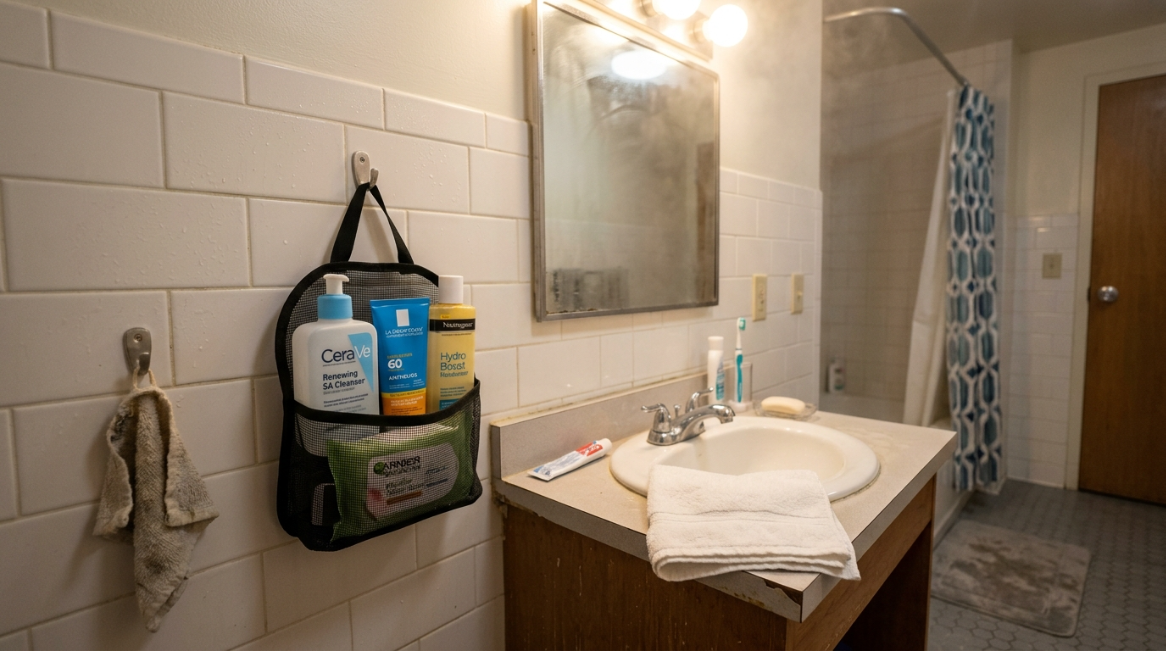
Keep your products in a small shower caddy you can grab and go. I used a mesh one from Amazon that cost $7 and held everything I needed. Wash your pillowcase once a week, or at minimum flip it to the clean side halfway through the week. Keep a pack of micellar water wipes (Garnier makes great ones) in your desk drawer for nights when you truly cannot make it to the bathroom. Removing makeup or sunscreen with a wipe is always better than sleeping in it.
FAQs
What is the best skincare routine for college students with acne?
Stick to a gentle cleanser, oil-free moisturizer, sunscreen, and one acne treatment like salicylic acid or benzoyl peroxide. Don't pile on multiple actives at once. If drugstore products aren't helping after eight weeks of consistent use, visit your campus health center. Many schools offer dermatology referrals at reduced cost or covered by student health fees.
How much should a college student spend on skincare?
You can build a solid routine for $30 to $50 that lasts at least a month. Brands like CeraVe, Cetaphil, The Ordinary, and Neutrogena make effective products at student-friendly prices. You don't need luxury brands to get good results. Spend your money on proven ingredients, not fancy packaging or influencer endorsements.
Can stress from college cause skin problems?
Absolutely. Stress raises cortisol, which increases oil production and inflammation. That's why breakouts often pop up right before finals or big presentations. Managing stress through sleep, exercise, or even just stepping away from your textbook for 20 minutes can genuinely improve your skin alongside your actual routine.
Should college students use anti-aging products?
Sunscreen is the single best anti-aging product you can use at any age, and you should already be wearing it daily. Beyond that, most college students don't need retinol or anti-wrinkle creams yet. Focus on hydration, sun protection, and treating current concerns like acne or hyperpigmentation. You've got time.
How do I stick to a skincare routine with a busy college schedule?
Keep it short. Three steps morning, two to three steps at night. Put your products where you'll see them, next to your toothbrush or on your desk. Pair skincare with something you already do daily so it becomes automatic. If I can maintain a routine through finals week on three hours of sleep, you absolutely can too.
Conclusion
Your skin doesn't need a complicated routine or expensive products to look and feel good during college. It needs consistency, a few solid basics, and a little patience while things improve. What's the one skincare step you keep skipping that you know you should start doing?